Showing posts with label Writing. Show all posts

Thursday, July 15, 2010

Time: it keeps on ticking

Today at Summer Writing Camp, our Sacred Writing Time prompt was really just one word:

TIME

Here is what I wrote:

Cecilia Braddock had the great misfortune of being the only girl in the history of time for whom it ran backward. She looked right; it wasn't that obvious at first.
She was born a mewling infant with the customary downy hair and angry skin and tight-fisted wailing, but even the myopic nurse who administered Cecilia's first dose of HIV commented, squinting from frantic infant to concerned mother. "This one's got wise eyes, missus," she said, passing Cecilia to those desperate arms. But Maggie couldn't think about Cecilia's eyes--wise or not--not when the angry spot on her baby's wrinkled thigh was already swelling in protest.
Cecilia, though, she heard the nurse and agreed heartily, whilst also deploring the idea that someone could be so observant and yet so cruel. That needle, glittering cold, inserted so callously into the skin pinched between thumb and forefinger, injecting hot and pain into a leg that had just hours before recovered from the trauma of birth.
While Maggie cradled her and cooed to her, then dropped into a doze, her arms still clutching the becalmed Cecilia, the baby looked about the room. Without any tutelage, she could read. Not just the directions on the IV bag printed in English, but also Spanish, French, German, Mandarin, and Arabic.
She had no idea, then, how anomalous she was. Nor would she likely have cared. The window revealed a sky gray with smog and a few pigeons struggling for purchase on the thin limestone lip of the building across the street. Which had been built in 1926, she knew, designed by Abraham Parker, with eighteen floors and two elevators, both of which were still operational--an uncommon preservation in this city that preferred new to old always.
Cecilia didn't consider how she knew language or architecture. She just accepted it, like she had the first bright lights, the smothering cold, the formula in a bottle--sustenance oral instead of umbilical.
Only Cecilia's father seemed to understand her. He arrived as dusk settled over the city, his tie askew and his hair rumpled. He had been the other man on the outskirts of her birth, Cecilia realized, the one who had nodded, glanced at his watch, and left before she had drawn her fourth breath.
"Father," she said when he walked into the room, and he looked up, startled, dropping his jacket on the floor. Blinking, Devon unfolded his glasses and hooked them around his ears.
"Cecilia," he asked, "did you speak?"
Maggie was snoring softly, so Cecilia had to raise her voice. "Why didn't you stay?" Cecilia asked, recognizing the querulous in her tone and despising it.
Carefully, carefully, Devon lifted Cecilia from Maggie's arms and carried her to a chair near the window. He didn't answer her question. "Who are you?" he asked, looking hard into her eyes.
"I'm your child."
"Yes--but--" Devon's brow wrinkled.
"Babies don't usually talk," Cecilia supplied.
"How long have you--"
"Since I was born, I know for certain. But there are a few flashes I recall from the darkness before. It is possible I began to be cognizant in utero, but it was so dark, so muffled."
Devon shook his head, shock darkening his eyes as belief settled in. "I've never heard of anything like this," he said. "Not any time, anywhere. I wonder--"
Cecilia wondered if her father ever completed what he began.

Tuesday, July 13, 2010

Summer Writing Camp

Last year, my friend Elizabeth Valente approached me with an idea to co-teach a summer writing camp for young writers. She teachers middle grades at Trinity with Clint, and she's a great language arts teacher. She knew of a number of students in seventh and eighth grades who loved Creative Writing, and she knew I loved teaching it.
So, we hashed out a plan for the week-long writing camp, and the first year was a great success. This year we modified our format a bit as well as our location, and the first two days have been fabulous.
We start each day at 9 with Sacred Writing Time, a time in which we provide the students with a prompt. They can follow the suggestion, but they don't have to. After that, we have a mini-lesson, and then most of the day is devoted to time for students to write individually, a time in which we write ourselves and also offer our advice and suggestions individually. Students also have time to break into small groups to share their work, their ideas, their triumphs and frustrations.
For those of you who like a writing challenge, I thought I'd share our first two Sacred Writing Time prompts. Enjoy!

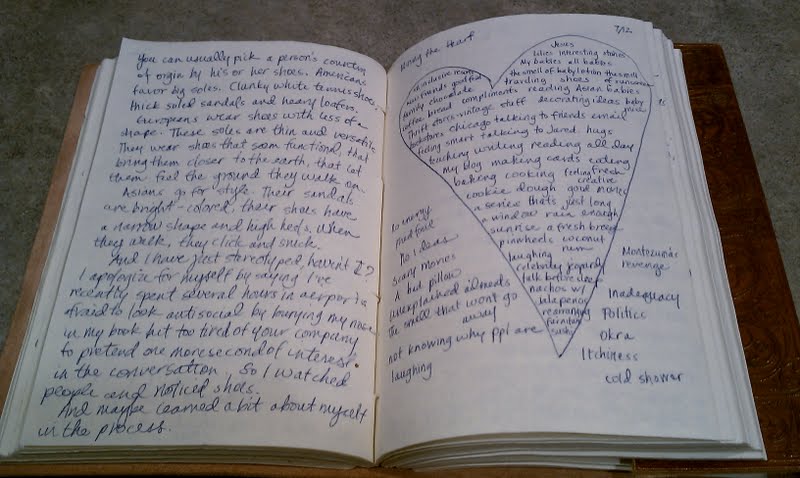
Day One: Mining the Heart (well, actually this was our mini-lesson, but it's like a SWT activity)
On a sheet of paper, draw a heart that nearly fills the page. Inside the heart list things you love, things you feel passionately about. If you'd like you can write things you despise or dislike outside the heart. Hopefully, doing this will inspire you with writing ideas. (Mine is below)


Day Two: Where I'm From poem
First, list any objects or people or sayings or events that are integral to who you are. Think back to childhood, to your family life, to hobbies and friends, to teen years and early adult years. Then find a way to organize those things into stanzas. Try to be specific and evoke a sense of who you are.

Here is a snippet of a sample we read:
i'm from cub scouts
and demolay,
from tiddlywinks,
black licorice,
and bazooka bubblegum,
from "squeeze my finger"
and "just try it--you'll like it,"
excerpt taken from poem by Hallie Herz in Nancie Atwell's book Naming the World: A Year of Poems and Lessons

Here is my poem (still a rough draft):
I am from Greiner Gardens
which once boasted three of the vegetable variety
but now just one--
unless
you count flower beds and
thereby can revert (comfortably) to the plural.
I am from Rich and Laura
who had--as he once said--
the gift of giving
birth
and so she did to seven of us
(blond stair steps people called us).
I am from compost bins brimming with coffee
grounds sprouting a kicking pair of
outraged young legs
and (purportedly) at least one mouse
I am from Grandpa's farm--the barn floor streaked
with sunlit fingers
hay dust puffing as we jumped
onto a forbidden pile.
I am from Pleasant Lake where friends
are made as easily as mud
but none are mine

I am from enormous green eyeglasses
and a hard-earned Polo shirt
which I wore too often
I know: photos don't lie
But I just wanted the mantle of real fashion
to touch me, if only briefly
I am from curly hair
that bounces when I'm happy
and from the small rebellion of wearing flip
flops till frost nips my toes

I am from chocolate shops
the smooth dark depths
the elucidating depths
as I've grown a bit of discrimination
and bypassed Hershey for Lindor
and then the really good stuff
I am from the chocolaterie in Chicago that
I can't find again
and from the one in Ashville--the Chocolate
Fetish, where each truffle enfolds
a world of flavors
Now I am from snobbery
as I cross desperate arms
before a glassy case, armed against
inferior mass production

I am from bookstores dark and musty--weighted
with the dust of wisdom and the fragility of type
tottering moldering piles
But also from Horizon Books on Front Street
and Schuler's on Grand River
those havens thick with new paper and fresh glue
of fresh brewing coffee and raspberry-
white chocolate scones

I am from snapping cold blue-gray sunrises
in the moment when night yields to day
as I sit awake too early on a Saturday in February
drinking coffee that is still too hot
And I am from the grandeur God paints
each evening which even Hopkins struggled
to convey
As I sit on the patio at Camp Arcadia,
glowing with reflected glory, and wish for words

Friday, July 2, 2010

It's been six years since I was first asked to teach Creative Writing at the high school where I teach, and with every trimester that passes, I fall a little bit more in love with teaching it. Not to say I didn't love teaching it from the first moment of the first class; I did. But now, I am even more enraptured than ever.
So, as I was perusing the bargain racks at my local bookstore and saw this baby for only 3.99, I thought I might have something in common with the main character.

(picture of cover links to author's blog)

Arabella Hicks is (just like me) a wannabe novelist struggling with her text (although she, poor thing, has been struggling for seven years and I just wrangled with mine for two before completely giving up on the thing) (don't know which is more pathetic, really). She is a freelance editor, but also (here comes the like-Kir part of the book) teaches a creative writing class. Arabella, though, teaches an adult ed class. Her collection of students is quite a mixed bag. A couple nut jobs, a guy fascinated with porn, another guy who won't stop asking "craft questions," a pill popping suburbian mom, and a closet transvestite. Oh, and an older guy who dresses fabulously--and who spends most of the class period hitting on her. I don't usually have such an eclectic collection in my classroom.

Arabella juggles her time between classes with the work she hates and visits with her mother, which she hates almost as much. Arabella had to put her mother in a nursing home, and she has recently become quite frail. But Vera's frailty doesn't stop her from putting Arabella in her place. And of course, Arabella struggles with the guilt she feels for not caring for her mother at home.

It's a quick read, and I enjoyed Arabella's lessons and lectures immensely. The stuff about her mother felt a bit whiny, though, and there were times Arabella just lost all my sympathy. She floundered through her life most of the time, never able to figure out what she wanted and how she was going to get it. She knew she wasn't happy, but she couldn't figure out why. But instead of bending her brain to that issue, she just complained about it.

Here's something I found, though, on page 52 that spoke so clearly to how and why I teach:

Arabella's mom was asking her why she teaches and whether it really is possible to teach someone to write.

"It's not so much about teaching them the craft of writing," Arabella says, "because they could probably figure that out from reading a book...It's about creating an environment in which they think they can write. That's the secret of a writing class. A good teacher makes her students feel secure enough to write their stories."

Exactly. So, students of writing, here are some exercises for you straight from Arabella's class.

1) Make a list of your five obsessions. Now write a few paragraphs about one of them.

2) Think of a person from history who intrigues you. Write a description of that person eating a meal. What would he eat? How would he eat? Who would eat with him? What would they say?

3) A boat sinks during a storm, and only ten of its passengers make it onto the lifeboat. One by one the survivors are knocked off until, after a month at sea, only two survivors are left. There is not enough food for both of them, and one of them is going to have to get rid of the other. One of them is a teenage girl who is very strong for her age, but she is blind. The other is a musician from a successful boys' band. He is twenty-six years old and smaller than the girl. Who will survive? Write the final scene.

4) Think about a family gathering: a holiday, a birthday, a funeral. Write about that gathering in the first person from the point of view of a child.

5) Write about a place that was important to you growing up, but don't put people in it. Just describe it as though you were painting a picture with words.

6) Two people are having a conversation. It can be any two people you want, but this is the first line of dialogue: "Kiss me."

7) Imagine a moment of crisis: someone shooting a bullet into you, someone about to be hung, someone going under anesthesia, someone falling in love at first sight across a crowded room. Write a few paragraphs describing the crisis, trying to expand time as you write so that the moment becomes as tense as possible.

8) Choose a novel or short story that you like and try to discover its theme. How does the author get the theme across? Title? Plot? Names of characters?

9) This is an exercise in learning to find creative solutions or how to write yourself out of a corner. There is a man sitting in a tree, and he is wearing a tutu. What happened?

Try one of these exercises, and let me know how it turns out.

Exercises taken from Breen, Susan. The Fiction Class. New York: Plume, 2008.

Tuesday, April 27, 2010

Sabbatical Proposal

Dear Principal:

I am writing to request permission to take a sabbatical. Before you start to hold up your hands and shake your head, just give it a thought. Forget about budgets and money and think about how illustrious our school could become. Will become.
Think about what great work I could accomplish if I had the time to devote my brain power fully to writing each day for 365 days. Not just the few hours (more like minutes, really) between the last bell and the clock at home that ticks sluggishly by as I grade yet another paper.
Here is what I propose: let me have just one teensy little school year. Just one. Maybe one every five years. In that year, you can fill my teaching position with someone else while I stay home and write. Of course, I will still also draw a salary and will need the assurance that I'll get to slide right back into my original position after the year is up.
In exchange for this, I promise to spend the hours from 7:30 till 2:30 each week day diligently writing. I will finish my novel, keep up my blog, and send out query letters to prospective agents. By the end of the year, you will be able to tell the school board that you have a best selling authoress on staff. I will even donate an autographed copy of my novel to the library. I will come back to school rejuvenated, ready to devote a fully un-preoccupied brain to my lesson plans and grading and teaching. I will not be distracted by that pesky novel that's chirping away in my brain, battering against my skull in a desperate hope for its release. Well, okay. Actually, I probably will. There's always something new. But I should be able to stave it off, resting on the laurels of my publishing deal, content to wait five more years until the next sabbatical.
I really can't fathom how you could pass this opportunity up, really. Although the school board may balk initially at the idea of awarding a sabbatical to a teacher, it is truly a win-win situation for all involved. You will be lauded as that rarest of administrators: one who can look beyond dollar signs to the true value of the written word, one who truly values the arts. In truth, you will likely receive national recognition, at the least from the NEA, for your commitment to fostering the voice of this one English teacher, the girl who just needs a bit more time to foster her genius. The school board will surely be able to glean a bit of that reflected glory, as well. The district will have the distinct honor of calling a celebrated authoress one of its own.
Thank you for considering my proposal, Mr. Principal, and I look eagerly forward to hearing your response.

With all seriousness,

Me

Tuesday, January 19, 2010

A confession

Have you ever noticed that sharing guilty pleasures is okay in some circles and taboo in others? I guess it depends on the guilty pleasure. Good bread: most would agree. Chocolate: nothing to feel guilty about there. Wearing the happy pants as often as possible: certainly acceptable. But I have one guilty pleasure I have never shared with my fellow English teachers or with other writers. Why? They would laugh themselves silly at me. And I don't much like to be laughed at.
But it's a New Year, and I'm feeling brave. And I just got done re-reading one of my favorite series. So here goes: I LOVE reading fantasy. Good fantasy. And finally, I am not ashamed to admit it. Here are books that qualify as good fantasy, in my opinion (in no particular order):
1. The whole Deathgate Cycle by Weis and Hickman
2. Anything by Ursula leGuin, especially the Wizard of Earthsea series
3. Ditto for Jane Yolen
4. The Exiles series by Melanie Rawn (which I would like even better if she'd finish book three and publish it! I want answers, woman!)

5. Illusion by Paula Volsky
6. Madeleine l'Engle. Period.
7. The Dark is Rising series by Susan Cooper
8. Harry Potter. Seriously.
9. Percy Jackson and the Olympians by Rick Riordan

10. ANYTHING by Patricia McKillip (especially, though, Ombria in Shadow)
11. The Bartimaeus Trilogy by Jonathan Stroud

This is why I like fantasy. In any other fiction, the author can take for granted the fact that the reader has heard of the setting, has some general knowledge of place. The rules for that setting have been created; hence, the author needs only create plot and characters. (I say only as if this is an easy task; I know it's not EASY, but bear with me.) In fantasy, the author must not only create the plot and characters, she must also create the world. She must consider geography, social customs, food, names, history, racial tension, the rules of magic and so much else besides. Clothing, money, food, foreign languages, modes of transportation. It's amazing. And whilst juggling all these creative ideas, the writer of good fantasy (like those listed above) also are masters at plot and character development.
I don't know why my fellow teachers and writers turn up their noses at fantasy. Some say it's not "real" literature, that it is too new as a genre, that the plots are too predictable. Whatever. Hogwash.
And here's something better: I AM going to start writing again, and this time, it's going to be fantasy. So there. I have been percolating an idea (percolating: I want more coffee) for a few months now, and I think it's past time to dust off my new notebook and get back to writing.
Keep me honest, dear readers. Check in on me. And thanks for listening.

Sunday, November 22, 2009

The Edge of Things

When Torren lifted his foot to step out of the woods, a silent wave shivered down his bones and tossed him gracelessly to the wood-floor, which was thick with scarlet leaves and the earthy scent of fungus. When he opened his eyes, his breath caught round in his throat, he realized his back cricked with a rather small pain, and he reached his long earth-singer’s fingers back to warm it. Humming a healing song, he felt the light warm the ache away.
He crouched then, elbows on his knees, and considered. Although he had seen twenty midsummers, he was young in his tribe’s reckoning, and his training had lately kept him confined to Master Althus’s hut at the edge of the leaf-hall. But it had been Master Althus himself who had sent Torren out before dawn broke the sky with a request for iron from the smithy in the village a half day’s run down the forest road.
“Your feet are faster than mine,” Althus said with a grunt. “You go.”
Sucking a nervous breath, Torren had nodded. “Should I take my bow?”
“Hells no. And announce yourself to the queen’s men? Your knife is all the protection you need out there—that and those fleet feet of yours. Borrow some clothing from Rourke. And cover your ears.”
Althus had rolled back into sleep, leaving it to Torren to rouse Rourke before dawn to beg the rough dun tunic and breeches the townsfolk wore.
Torren scratched his leg and then felt in the leaves for a stick. Holding it before him, he stood and prodded the bright light beyond the leaf-dappled edge of the forest. Nothing happened. He stepped forward until his fingertips were just at the edge of that veil separating light and dark. He froze, took a hard breath, and let just the sliver of one fingernail cross into light. The stick shattered in his hand.

Althus peered through the blue-grey smoke of his long thin pipe. “Tell me again, more slowly this time.”
Torren took a breath, sucking air and the calming mint of Althus’s pipe smoke deep into his lungs. He began with the sound and ended with the slivers of wood falling from his fingers.
Althus leaned back against the wall and pulled on his pipe, his eyes closed. Smoke drifted up and over his head, accumulating and hovering in a cloud, a fragrant cloud—moments passed and Torren felt his eyes grow heavy and he swayed in his perch. He bit the inside of his cheek, bit it hard and sat upright.
“Pain as a stimulant,” Althus murmured and the cloud evaporated. “Interesting choice, Torren.” He leaned forward, his pale blue eyes as cold as bitter ice. “You have much to learn yet.”
“Why did the forest not let me leave?” Torren asked. “Do you know?”
Althus closed his eyes. “I have many thoughts and may tell you in time. Meanwhile, I want you to do two things. First, compose a list of possibilities. What may the sound have been? What might it portend? And also, consider a better stimulant. Pain—self-inflicted as that was—will only weaken you.” He sucked on his pipe, closed his eyes, and leaned back. Torren knew he had been dismissed.
It was far more easy to roam the sun-streamed leaf halls of Manluviár than to focus on the task Althus had set him. Each room was built of trees charmed to shelter the woodfolk from the elements; each room held treasures formed in ancient days, treasures whose craftsmanship had been lost as his race diminished, their magic dimmed, their ageless bodies fallen prey to the grey-fletched arrows of Queen Asyn’s men.
This queen had appeared one winter out of the deeps of the Grey Mountains just as the white-bearded human king was dying, and she had settled her gaunt, black-robed form into his vacant throne, and she had summoned a silent army of men, fierce of eye and swift of arrow, to surround her. The king had been burned with indecent haste, and a rumor--more than a rumor--had reached the Folk of a flicker of his eyelid as the flames licked hungrily at his robes. Some said his hand twitched or maybe clenched. One rumor said the new queen had tossed another brand onto the fire, her eyes glowing (maybe with fireglow or maybe--none would complete the sentence). But all agreed that when she cast that branch on the pyre, the fire had leapt up and consumed the body of the king that was.

Tuesday, August 4, 2009

On Writing


It's interesting to read old journal entries, for I find that when I'm not hashing out a new story idea or telling about something funny one of my kids has done, I lament the fact that I'm not writing--and I know I should be. But here's the funny thing: even though I complain about not writing, and even though I find excuses not to write, once I swallow the obstacles and dive in, I get lost.
It happened today. I sat down at a computer to work on a story I started last summer (and forgot about--good thing I wrote the first few pages down in a safe place!) and once I started typing, I was there, in that good place. The place I am when I write.
The rumble in my stomach, the itch on my shoulder, the soft whisper of birds, everything fades away. I inhabit this other world that I have created, watching what the characters do and moving my pen or keys as furiously fast as I can as the story emerges. It's magic and it's exciting and I wind up feeling more buzzed than I've ever felt on wine.
I'm eager to get back to that place tomorrow...might even skimp on some of my housework tonight and dive back in.

Wednesday, July 22, 2009

Good news!

So I got a letter in the mail yesterday, addressed in my own writing. I looked at in for a second in bewilderment before I realized what it was: a reply from one of the agents I had sent a query to. I wasn't very optimistic as I opened it, thinking the chance of a positive response was very small. After all, everything I've read and heard about querying has been overwhelmingly pessimistic. I pulled out a blue printed sheet and scanned it, finally noticing the red check at the bottom. Yes, that's right! She wants to see my complete manuscript! I think I may have squealed, for Clint came running, and I showed him. Hugs ensued and a bit of jumping up and down. Then we settled down to talk logistics. I needed to go the printer and make a clean copy.
$23.17 later, all 312 pages are neatly stacked and ready to mail out, which I'm about to head out and take care of. Then, it's just a matter of waiting. Waiting for her to read it, to decide whether she thinks it's marketable, and if so, to convince a publisher that it is.
Your prayers and good wishes are coveted.

Thursday, July 9, 2009

The Plunge

I have officially done it. Not the wimpy way like I did last time (a half-hearted email) but FOR REAL. I sat my little self down and typed up a query letter and a synopsis of my novel (the one about the French Revolution--death and betrayal--that one) and sent out packets to some literary agents.
For those of you not so well versed in the publishing protocols, that's what you have to do, really, before you can find your book on the shelf at Schulers. You have to convince an agent to represent your book, then that agent sells it to a publishing house, and the publisher--ah, publishes the book. THEN you can find it on the shelf at Schulers.
It's a daunting endeavor for me, though, because whilst I was at my residencies for my MFA, the mantra we all chanted to ourselves at night, so lulling and soothing, was this: "No book without an agent, no agent without a book." Yeah, the same thing that happens in the work world happens in the book world. You can't land a job without experience, but you can't get experience without a job. And most agents don't like to handle unpublished authors...but you can't get published without an agent. Sigh.
But I mailed out my packets this afternoon, and I'm crossing my fingers. But I won't keep them crossed--it can take anywhere from four weeks to never to hear back. So meanwhile, I'll just keep writing, keep reading, keep etsy-crafting (I'll get my shop up soon! Promise!), and keep doing all the other things that take up my time. Oh, and blogging too.

Monday, January 5, 2009

Here I Go

Just printed off my first VERY rough draft of the novel I wrote in November during National Novel Writing Month. Keeping in mind it's a very rough draft, here's a tidbit from page...hmm... oh, 11. How about that?

“So that’s how it is. I get it. See you tomorrow.” And he left, but he turned to take one more look before he walked out the door, as though he knew my eyes would be following his straight broad back, shaping the hollow between those long muscles under his shirt with my eyes. He was too conceited for me, I knew, and far too beautiful. But it had been a long time since anyone had looked at me the way he did, whether his looks were genuine or not.
At home, I sat in front of the TV with a bowl of cereal, crunching away while I watched my boyfriend Ross chase Rachel behind the dusty curved glass. My life was pitiful, I knew. Something about Ross attracted me, though, and had ever since the first season of Friends, back when I was still in junior high. Something about his geeky brainy-ness was appealing. Maybe the fact that he didn’t know how cute he was, and that he was awkward and shy in unfamiliar social situations, just like me. Nothing like Paul, but maybe I was growing up now, no longer interested in a nerd like Ross. Paul was my adult fantasy, and indulging that fantasy was harmless, especially when I was sitting on my ratty Ikea couch with an empty cereal bowl balanced on my knee.

I don't know...what do you think?

Saturday, December 20, 2008

It's Not Even New Year's

So much for good intentions, eh? I finished the novel in a whirlwind of typing, and as I look over my (now, I realize, WAY too optimistic) list of plans for the rest of my days in 2008, I see I've done...hmm...a lot of reading. That was on there somewhere, right?
And get ready for Christmas. I can check that off. As of today, shopping is almost done. Two more little things to put in a couple stockings. Oh, and a birthday present for my mom. Whose birthday is tomorrow. Any ideas? Hmm. Not a lot of time to come up with something great.
So here I am at 9pm, just finished a delicious bowl of TurtleFudgeBrownie ice cream, and I'm thinking about those good intentions.
I've got one notch on my belt though, something I'm proud of. I did submit an essay to an online magazine. Miranda Literary Magazine. And they accepted it! Woo-hoo. Thanks, Ronster.
So I'll send out a note when the issue hits the proverbial press, and you can check me out in online print. Ron, the editor, says they will be offering a new feature with this issue, print on demand, so if you'd like a paper copy, let me know and I can get one for you. No idea how much it'll cost.
Revised goal then, for Christmas break:
Send out 5 query letters
Finish grading Creative Writing stories (should probably put that first)
Do first major revision for latest novel

And goal for the rest of the winter:
10 more query letters
One contest submission
Submit novel to Amazon Breakthrough Novel Contest

Keep me honest! Make sure I do it.

Saturday, November 29, 2008

Drumroll please

After 29 grueling days of feverish typing, I am pleased to announce that my new novel, presently nameless, is finished 27 hours ahead of schedule. True, I did type almost all day today, to the probable frustration of my family, but it's done.

How long is it? You ask. Baby _______ weighs in at 51,000 words (or so) (unfortunately, I shut down the laptop before I checked my final word count) and 172 pages.

Am I glad it's done? Heck, yeah. I've got some reading to catch up on.

What next?
Hmm, more faithful blog posts.
Look for two different sorts of agents.
Check out wordhustler.com and find something short to write.
Hello! Read some more.
(Ugh) Christmas shopping.
And...spend time with the fam. Yeah, sorry guys, you shouldn't be at the bottom of the list. Thanks for being so bifurcating awesome.

Thursday, November 6, 2008

Update

Novel started: November 1
Average daily word count: 1845 (just kidding...I have no idea what the average is, but I'm doing all right)
Number of days I've missed writing so far: NONE
Total pages to date: 32

That's it.

Monday, September 22, 2008

Pie Making

she bends over the sink and
water trickles on fingers (cracked with use)
which curl around the flashing silver
handle of the knife
as she whittles away red
skin leaving
white flesh exposed to light

naked fruit rests in a white enamel
bowl by her elbow
each waiting to be sliced
and hollowed of its core

the mound has grown in the bowl
so tall she turns off the water
and begins to slice
water dries on her hands which stick
with the transparent blood
of apples

a crust drapes over the pie pan
and apples sliced and cored
tossed now with sugar and flour and
cinnamon
fall into the dish

her hands are floured
dusted white in cracks and nail beds
as she unrolls the top and crimps the edges

(her hands are washed and dried)
then she slides the pie into the oven

after she squints at the timer to set it
she presses clean hands to her back
and tries to straighten out the pain
into a thin manageable line

Tuesday, July 29, 2008

Finding inspiration

Every writer gets depressed, right? Maybe depression and writing are linked somehow. Maybe writers are depressed (depressing?) people, or maybe our depression leads us to write. I don't know what the link is, but every other writer I know has suffered as I have lately been suffering. It's all linked to my writing, too (of course). Everything I write lately feels DUMB, feels LACKLUSTER, feels SACCHARINE. Where are the good ideas? And why aren't they in my brain?

This is how I felt last week. It should have been a great week for writing, because I was on vacation and I got to hang around the beach (Lake Michigan) for an entire week just sucking in inspiration with a few grains of sand and the smell of water, but it wasn't. Nothing came. I spent most of my time lazing around and chatting with my siblings and their spouses. I tried to write but everything was ___________ (see adjectives above or supply similar words).

And then I read a book, a small book, by a man named Peter Selgin. I attended one of his workshops a year or so ago, and I wanted to buy one of his books then, but they disappeared too quickly into the greedy hands of my classmates. I finally broke down and ordered one a few weeks ago and then finally broke down and read it last week (in the last few days of my vacation). It's called By Cunning and Craft, and it has all sorts of PRACTICAL tips for writing fiction.
Peter acknowledges that writing is not easy, but he says that it is a craft that can be learned with diligence and determination. And guess what makes a writer better? Anyone? Anyone? Yes, that's right. Practice.
So here we go. I'm really going to do it now. I'm done whining about not having any good ideas. I'm just going to write (and I'll keep Selgin's book close at hand in case I get stuck).

Friday, July 11, 2008

Death Brush

I.
Death brushed my shoulder in Zurich on a cloudy April morning. Seven months pregrant, my belly a flag swelling before me, I stepped into the street following the heels of a (beloved) man hurrying to buy cheeseburgers for a Euro.
II.
This Zurich was not quaint like Salzburg and most of Bavaria. The streets were broad and modern highrises reflected metallic shadows that chilled my neck. The Golden Arches were twinned smiles in reverse though--a familiar welcome--and they beckoned me (reckless) into danger.
III.
I am American. I don't speak Swiss. I don't speak the language of trolleymen. How was I to know that his impatientbleatbleat meant stop instead of go? Graciously forgiving most minor faults, I impose that gentility on others (often misreading). Who would plow down a girl with bouncing ringlets a wide smile a swollen belly?
IV.
I trotted into the street/the trolley's bell became a whine that didnotstop/itwascoming/Icouldn't turnback/itwasgoingtohitme
V.
Sobbing/laughing? Angry/relieved? I felt the chill wind of the trolley passing at my heels as I tumbled running into my beloved's wiry arms. On a drear April morning in a cold city in Switzerland, my belly swollen with child, I ran faster than death.

Sunday, July 6, 2008

On wrinkles

I am a purger, not a saver. I have a small container of mementos from my childhood, and each of my children has a "box" of keepsakes from babyhood and another from school. That's it. Oh, and my husband has his own box: the box of all the "Unique and Creative" decorating...ah...items he had when in his dorm room when we met.
And while that purging tendency leads to a very organized home and office, it often leads to regret as well. It's been more than once that I've looked in my closet for a certain shirt--only to recall that I donated it to Goodwill a few weeks before. And I have looked with speculation at the garbage can, wondering whether I SHOULD dig out that homework paper my son brought home--the one I just looked at and tossed--the one that now lies buried beneath coffee grounds, a banana peel, and three wadded paper napkins. Probably not. He'll bring home more papers soon enough.
How often do we throw out ideas in our writing? Too often. And how often do we regret those decisions to toss instead of keep? Ditto. It's hard, though, to find a place to store all those wrinkled pages, a place to keep them safe from coffee grounds and banana peels and wadded napkins. For me, the answer is this blog. I know that often those very ideas that seem lackluster today can have a certain gleam tomorrow, especially when they've been polished a bit.
Welcome to my wastebasket.

Saturday, July 5, 2008

Finding time to write

Every workshop and lecture I've attended has emphasized the importance of daily practiced writing. This makes sense. How else can a writer create her craft? But it's summer vacation! And I've been given a blessed reprieve from reading student essays. I want to read, to sink into a good book. Writing feels like homework now, and in just three weeks, I have become far too undisciplined to do anything that smells like school.
So I carry my notebook and a good pen around with me as a goad and a threat. And I crack open another "new" book (at least I'm using the public library now--I've become so frugal). I tell myself, just one chapter and then I'll write another few pages. Then the book gets really good and so I read a few more chapters. A breeze comes in the window and teases at the edges of my notebook. I hear the flutter and it sounds like admonishment. I decide to stop reading in the middle of a chapter (they always end with cliff-hangers--can't stop there). And I put my book on the floor and pick up my pen and notebook.
I like to write on paper first. I found that out when I was writing my first novel (not yet published, but...http://www.amazon.com/A-Minor-Revolution/dp/B00124COPC/ref=sr_1_1?ie=UTF8&s=books&qid=1215302870&sr=8-1. It's something, at least) that paper and pen work for me. I am a tactile person, and I like the feel of fabric and paper, beads and ribbon when I create art. And I like the sound of a pen's nib scratching paper better than the sound of keystrokes on a computer. So I begin to write.
And then magic happens. The noise around me doesn't stop. The TV is on, and my family is watching it. Jared, my two year old, climbs into my lap and gives me a sticky kiss. "Hey, mama," he says, and I hear it, but I am also in Algiers while a young private fixes the engine to his superior's Jeep. I can feel the sun baking the back of his neck and I can taste the spice in the air. My fingers feel a little greasy too as he wipes his hands on the rag tucked into his pocket. And I write.
And tomorrow, when I sit in my chair with a cup of sugared, creamed coffee beside me, maybe I'll remember this moment and leave my book on the floor.
I am a writer, and I need to write.