Showing posts with label Teaching. Show all posts

Wednesday, January 4, 2012

The Importance of Things

When I told my English students yesterday that today would be show and tell day, some of them groaned. "I don't like talking in front of the class. It makes me feel like I wanna puke!" they complained. I ignored them, as I usually do (the complaints, not the children), and continued explaining that they needed to bring in an object that represented someone or something significant in their lives; they were going to use this experience to write a reflective essay later on this week.

They shuffled out of the room when the bell rang, leaving me to wonder what they might bring in for show and tell the next day.

This morning, as they drifted into the room, I heard one student ask, "Is today show and tell day?" and I groaned. I've had years like this before, where a class just doesn't put much effort into anything, and nearly every student shows either a cell phone or iPod or a classmate as a best friend.

I let myself begin to doubt them, so I was therefore unprepared for the depth of today's experience.

I began by showing this pewter pig.


My brother Thad got him for me when his 7th grade class went on a trip to Shipshewana. I don't remember if he got gifts for any of our other siblings, but he brought this little guy home for me. He's tiny (the pig, that is): maybe as big as a baby's fingernail. I carried him in my pocket every day for years, a talisman that reminded me I was loved. I seem to remember carrying him in my pocket for my first job interview, but I'm not sure if that's a true memory.


After I shared, students began to volunteer to share. A couple of girls shared about how their hockey teams had won medals or they had gone to an elite sports camp. One boy showed his baseball trophy. Then, a boy walked up to the front with a picture of his junior high baseball team. After he introduced his topic, he began to get choked up. As he wiped away tears, he told us why that season was so memorable: it was the last season he got to play with his friend, who died that fall in a car accident.


Next, a girl shared a picture of her family when she was young, saying it was the last picture taken before her parents divorced and the family was shattered. Another girl shared a picture of herself with her father, saying he had died soon after. A boy shared a book his grandfather bought just before he died of leukemia, and his grandmother had just recently given it to him to keep. On and on the stories unfolded, stories of love and loss and moving on.


They were not all sad stories. Three students brought in musical instruments (two guitars and a bassoon) and we listened to mini-concerts. A few more talked about athletic achievements. One girl said she really just wanted to live in a van in her mother's driveway when she grew up: the rent would be cheap and she could mooch meals off her mom.


But even the funny, silly stories had an emotion in common with the sad ones. As we shared and laughed and sometimes brushed away tears together, I think we grew closer as a class: we learned that there is pain in the world, there is death and sadness, and it doesn't matter whether you are at the top or the bottom of the teenage social food chain--or somewhere in the middle--tragedy can strike just as randomly as joy can, and by sharing with each other and learning from each other, we learn a bit about ourselves as well.

Monday, June 6, 2011

Commencement: Conquering a Fear


Board members, faculty, staff, parents, friends and family, graduates. It is a great honor to be standing before you on this special day.


I know it is said that time flies as you get older, and I always thought that was just a sneaky way less youthful people covered themselves after forgetting something, but in my advanced age (my birthday was yesterday) and wisdom, I have found it to be true. I blinked one day, and my daughter sprouted from a preschool student to a high school student, and the same thing has happened with you, graduates.


It truly does seem like yesterday that I met some of you for the first time, as you walked into my classroom on your first day of high school. Some of you were my STAR [homeroom] students, and some were World History or Creative Writing students. I remember how large your eyes were, how some of you stared around the classroom in awe, and how attentively you listened to me explain the rules of my classroom. It didn't take long for that shine of newness to wear off and soon you showed me who you truly were: not scared, shy freshmen, but young people who were (for the most part) ready to learn and ready to become a part of Napoleon history.


Time passed, and you grew older. Some of you went on to win praise from teachers for academic achievements. Some went on to win cheers on the field or the court or the track. Some won accolades for your art. Some of you kept your brilliance to yourself, but all of you cast a glow on your four years with us, and it is with a mixture of both pride and sadness that we watch you leave.


I look out at your faces, graduates, and I see the future sitting before me. And you are just as brilliant, just as eager for that future as you were four years ago—maybe more so. I look out at you and see tomorrow's lawyers and businessmen who are very very good at persuasion, some computer engineers, a baker or two, a professional golfer who really should trust me and buy some plaid pants, a couple of guys who will make tons of money playing video games if only they can figure out how, teachers, musicians, artists, movie critics. I see cosmetologists and machinists, construction engineers and nurses. You are our future, graduates, and we are so proud of you.


For some reason, I was afforded the great honor of giving the commencement address today. In a tiny part of my heart, I can't help but wonder if you graduates are sadistic people who enjoy torture. I am pretty sure I was quite clear last year when I said, looking certain of you straight in the eye: "I do not want to give the commencement address. I do not like speaking in public." Despite that, you asked, and I could not say no.


But then another part--a larger and wiser piece of my heart--told that whimpering tiny part of me that maybe you didn't ask me out of sadism but out of something else. Maybe you asked me to speak because you liked being in my class and you wanted to hear, one more time, what I have to say to you.


So this is what I have to say: I have discovered the key to happiness, and I am here to share it with you today.


Now I am not a millionaire and I will probably never be one. And when I googled myself , I only got 192 hits (which is actually not bad! I was pretty impressed!), so I'm not really famous outside of Jackson County. Or even in it, probably.


But even though I'm not on a list in Time or People or Forbes magazines, I have found a measure of success and the secret to living a happy life. Here it is: love one another.


You probably thought it was going to be more flashy, but I really think it is that simple. Here's why: when you walked into my classroom, I showed you that I care about you. I listened to you, I helped you fix your essays and figure out your relationships, I hugged you when you needed a hug. That's love, people, the kind of love I'm talking about. And in return, most of you probably found that the vibe in room 132 was a happy one, a safe and comfortable one, where learning could happen.


Loving others makes me happy, and I have found that that sort of happiness is contagious. So, here is my advice: when you talk with people—new friends or old, family or co-workers, find a way to love them. Look for the good in others and open your arms and your minds to the possibility that learning about people and sharing in their lives is more important than talking about yourself.


When you leave this place today, if you take that philosophy with you, you'll be on the road to happiness. Because when you love others, they usually love you back, and soon you'll find that your heart is overflowing with goodwill and you can't stop smiling.


I can't share any reputable journal articles with you proving my theory about the key to happiness, and I don't have scientific data to back this up. I'm just telling you what I have found to be true. When you meet new people, listen to them. Show them you care by shutting up about yourself and letting them talk. Give lots of hugs. Smile often. Appreciate what you have and stop wishing for more. Enjoy each moment. This is how I live my life, and it has brought me great joy and the success of being content with who I am. I pray it will work for you.


Now I can't sit down before I mention a few other words of advice and encouragement. I'm a happy person, but I'm also an observant person, and aside from watching for the bake sale carts, I like to watch people. I notice things. And I've noticed a few things about you that you might want to take into consideration.


Some of you would do well to find a hobby. It is so easy to waste time, to let yourself get distracted by your phone, your facebook, your games, your whatever. But haven't you ever found yourself blinking away the haze that settles when you've lost yourself in these mindless pursuits and thought, where has the time gone? Has it really been four hours? What have I accomplished? I'm telling you, it will be a very sad day if one day you blink and it is not just four hours that have passed but four years—or more. So find something constructive to do with your time, like a job. Study for your college classes. Read a book or play an instrument. Spend time with loved ones.


Some of you would do well to take more pride in who you are. Some of you have already figured this out, but I'm talking to those of you who haven't. You have talent, you have worth, you have gifts. I have seen them. Discover what they are and be proud of them. Don't worry about what other people think of you; celebrate yourself.


Some of you would do well to stop worrying about things you can't fix. There will always be troubles in the world, and there will always be tasks that are overwhelming or people who are too demanding. There will be days when your future looks bleak and hopeless, when you go to bed at night and wonder how you can possibly please everyone and accomplish everything you need to do the next day. But you can't worry about that. Worrying accomplishes nothing positive—it only makes you feel less capable and less confident. Instead, try to set your fears aside, breathe deeply, and meet the task as best you can. Sacrifice what is impossible for what is possible and do your best with that.


As I close today, I want you to know that we all have high hopes for you. As I said earlier, from the first day I met you, I knew that you were special. That you were destined for greatness. And you have fulfilled that early promise.


But in the four years you've spent in high school, as you've learned tough lessons and faced challenges that have brought you crying to your knees, some of you may have lost a little bit of that eagerness, that bright-eyed enthusiasm you had four years ago. I challenge you to find it again. Be shining examples in the world, showing them what it means to be a graduate of Napoleon High School. Your senior year is over, and your life is before you.


Reach for it, grasp it firmly, open your heart and your eyes to love, and follow that bright vision. I can't wait to see where it takes you.

Tuesday, July 13, 2010

Summer Writing Camp

Last year, my friend Elizabeth Valente approached me with an idea to co-teach a summer writing camp for young writers. She teachers middle grades at Trinity with Clint, and she's a great language arts teacher. She knew of a number of students in seventh and eighth grades who loved Creative Writing, and she knew I loved teaching it.
So, we hashed out a plan for the week-long writing camp, and the first year was a great success. This year we modified our format a bit as well as our location, and the first two days have been fabulous.
We start each day at 9 with Sacred Writing Time, a time in which we provide the students with a prompt. They can follow the suggestion, but they don't have to. After that, we have a mini-lesson, and then most of the day is devoted to time for students to write individually, a time in which we write ourselves and also offer our advice and suggestions individually. Students also have time to break into small groups to share their work, their ideas, their triumphs and frustrations.
For those of you who like a writing challenge, I thought I'd share our first two Sacred Writing Time prompts. Enjoy!

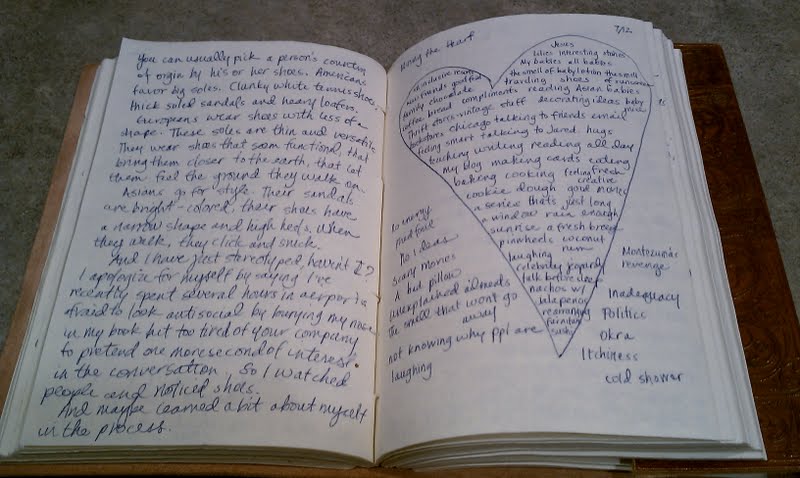
Day One: Mining the Heart (well, actually this was our mini-lesson, but it's like a SWT activity)
On a sheet of paper, draw a heart that nearly fills the page. Inside the heart list things you love, things you feel passionately about. If you'd like you can write things you despise or dislike outside the heart. Hopefully, doing this will inspire you with writing ideas. (Mine is below)


Day Two: Where I'm From poem
First, list any objects or people or sayings or events that are integral to who you are. Think back to childhood, to your family life, to hobbies and friends, to teen years and early adult years. Then find a way to organize those things into stanzas. Try to be specific and evoke a sense of who you are.

Here is a snippet of a sample we read:
i'm from cub scouts
and demolay,
from tiddlywinks,
black licorice,
and bazooka bubblegum,
from "squeeze my finger"
and "just try it--you'll like it,"
excerpt taken from poem by Hallie Herz in Nancie Atwell's book Naming the World: A Year of Poems and Lessons

Here is my poem (still a rough draft):
I am from Greiner Gardens
which once boasted three of the vegetable variety
but now just one--
unless
you count flower beds and
thereby can revert (comfortably) to the plural.
I am from Rich and Laura
who had--as he once said--
the gift of giving
birth
and so she did to seven of us
(blond stair steps people called us).
I am from compost bins brimming with coffee
grounds sprouting a kicking pair of
outraged young legs
and (purportedly) at least one mouse
I am from Grandpa's farm--the barn floor streaked
with sunlit fingers
hay dust puffing as we jumped
onto a forbidden pile.
I am from Pleasant Lake where friends
are made as easily as mud
but none are mine

I am from enormous green eyeglasses
and a hard-earned Polo shirt
which I wore too often
I know: photos don't lie
But I just wanted the mantle of real fashion
to touch me, if only briefly
I am from curly hair
that bounces when I'm happy
and from the small rebellion of wearing flip
flops till frost nips my toes

I am from chocolate shops
the smooth dark depths
the elucidating depths
as I've grown a bit of discrimination
and bypassed Hershey for Lindor
and then the really good stuff
I am from the chocolaterie in Chicago that
I can't find again
and from the one in Ashville--the Chocolate
Fetish, where each truffle enfolds
a world of flavors
Now I am from snobbery
as I cross desperate arms
before a glassy case, armed against
inferior mass production

I am from bookstores dark and musty--weighted
with the dust of wisdom and the fragility of type
tottering moldering piles
But also from Horizon Books on Front Street
and Schuler's on Grand River
those havens thick with new paper and fresh glue
of fresh brewing coffee and raspberry-
white chocolate scones

I am from snapping cold blue-gray sunrises
in the moment when night yields to day
as I sit awake too early on a Saturday in February
drinking coffee that is still too hot
And I am from the grandeur God paints
each evening which even Hopkins struggled
to convey
As I sit on the patio at Camp Arcadia,
glowing with reflected glory, and wish for words

Wednesday, June 16, 2010

On Reading

On Friday, the last day of school, I talked to my students for a moment before summer settled over their brains, its filmy promise of endless days at the lake so much more powerful than my speeches about reading and writing and literature. Fully cognizant of the chance that my words would fall on fallow ground in their summer-soaked minds, I had to at least try.

So, I said, it's been a great year (blah blah blah) and I've enjoyed having you all in class (more blah). And remember, if you want to become better readers and writers, the best way to do it is to read. Set yourselves a goal: try to read at least three books this summer.

As I looked out over their rapturous faces, I realized that not one of them was listening to me. Their ears were filled with the buzz of sunlight reflecting off rippling water.

Then, one of them blinked and turned to me. Then, he spoke. And all of his classmates slowly shook off their collective reverie to listen.

Books? he scoffed. Books are for rich people.

Rich people? I said, shocked. Are you serious?

Yeah, he repeated. Books are for rich people.

Well, I blustered. I'm not rich. And I read all the time.

Yeah, he replied. But you're an English teacher. (Clearly, we're in a category of our own.) (I tried to ignore the derision he shoveled onto that label.)


I looked around at the rest of the class. What do you think? Are books just for rich people?

Almost every one of them nodded. All but three of them. (Who are, of course, now my three favorite students.) I tried to persuade them, to plead with them, to show them the glory of the printed word one more time before they left. But their eyes had taken on the golden glow once more and their minds had fled to summery musings. They were lost to me--for the next three months. In September, I would start afresh, and this time, indoctrinate them much more forcefully (ahem-earnestly).

mwa-hahaha

Tuesday, April 27, 2010

Sabbatical Proposal

Dear Principal:

I am writing to request permission to take a sabbatical. Before you start to hold up your hands and shake your head, just give it a thought. Forget about budgets and money and think about how illustrious our school could become. Will become.
Think about what great work I could accomplish if I had the time to devote my brain power fully to writing each day for 365 days. Not just the few hours (more like minutes, really) between the last bell and the clock at home that ticks sluggishly by as I grade yet another paper.
Here is what I propose: let me have just one teensy little school year. Just one. Maybe one every five years. In that year, you can fill my teaching position with someone else while I stay home and write. Of course, I will still also draw a salary and will need the assurance that I'll get to slide right back into my original position after the year is up.
In exchange for this, I promise to spend the hours from 7:30 till 2:30 each week day diligently writing. I will finish my novel, keep up my blog, and send out query letters to prospective agents. By the end of the year, you will be able to tell the school board that you have a best selling authoress on staff. I will even donate an autographed copy of my novel to the library. I will come back to school rejuvenated, ready to devote a fully un-preoccupied brain to my lesson plans and grading and teaching. I will not be distracted by that pesky novel that's chirping away in my brain, battering against my skull in a desperate hope for its release. Well, okay. Actually, I probably will. There's always something new. But I should be able to stave it off, resting on the laurels of my publishing deal, content to wait five more years until the next sabbatical.
I really can't fathom how you could pass this opportunity up, really. Although the school board may balk initially at the idea of awarding a sabbatical to a teacher, it is truly a win-win situation for all involved. You will be lauded as that rarest of administrators: one who can look beyond dollar signs to the true value of the written word, one who truly values the arts. In truth, you will likely receive national recognition, at the least from the NEA, for your commitment to fostering the voice of this one English teacher, the girl who just needs a bit more time to foster her genius. The school board will surely be able to glean a bit of that reflected glory, as well. The district will have the distinct honor of calling a celebrated authoress one of its own.
Thank you for considering my proposal, Mr. Principal, and I look eagerly forward to hearing your response.

With all seriousness,

Me

Sunday, December 20, 2009

Reading History

The other day, I was chatting with a couple students after class about good books, and I may have let something embarrassing slip. I could tell by the shocked O I saw each mouth make, one shadowed by hints of a struggling dark mustache, the other as smooth as a ten year old's. I should have stopped right then and walked away, clutching my teacherly dignity tight around my shoulders, but I blundered on. By now, you're probably wondering what I said. I certainly would be. Here it is, preceded by a discreet but impressive drumroll: I told them they should never read their history books if they want to learn history. There. That's it. Horrible of me, isn't it?
And technically, I guess I shouldn't have said that, especially as a nominal member of the history department at my high school (I teach one class each trimester). And I suppose I should show some support for the curriculum I teach. And I suppose they may take my words too far to heart and begin refusing to read their assignments.
But if they pause to consider the intent of my startling announcement, they will know what I meant. And it is this: history, when read only in a textbook, IS dry and boring and will make even someone who loves the subject begin to weep in abject misery. (Maybe a little too harsh, still.)
Okay, here's what I really wanted them to discern: history can be positively FUN to learn if discovered in other ways. How about that? I don't think my department chair would eviscerate me for saying that.
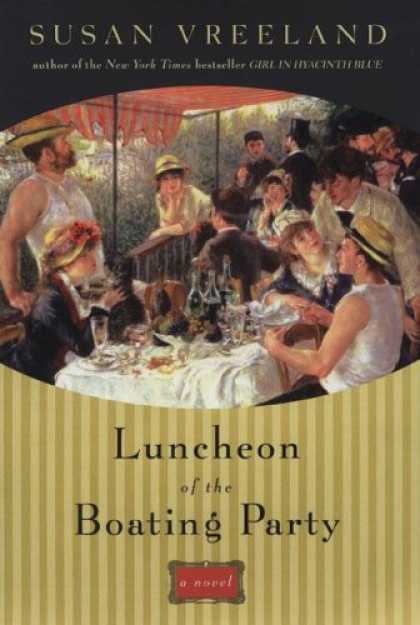
Case in point: the book Luncheon of the Boating Party by Susan Vreeland. I was drawn to the book for a)its cover and b)a recommendation from Sarah. Together, these resulted in a sale (and it didn't hurt that the hardcover had been discounted to FIVE NINTETY-NINE!). Just look at this! Wouldn't you want to buy it, too?


If you love art or history--or just a good story--you should read this book. It's also a great read for those who love FOOD. Yes, ladies, I said the magic word. It didn't create a craving for French food quite like Chocolat did, but it came a close second. Susan Vreeland uses a wealth of research and period detail to recreate Paris in 1880, when Impressionism was at its height and the modern world was beginning to make its presence known with things like factories along the Seine and a precursor to the Harley called a steam cycle.
Pierre-Auguste Renoir loves to paint because he falls in love with what he paints. Usually, this is women, and he has loved many. As I read the book, I found myself rooting for Alphonsine, a widow of the Franco-Prussian War, who lives and works at Maison Fournaise, which her father owns. It is a restaurant along the Seine, just outside Paris, a place where Parisians come to relax and celebrate the weekends.
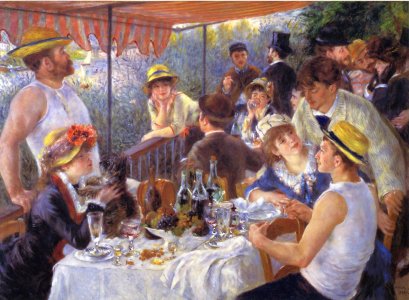
Together, Alphonsine and Auguste envision the idea of a painting of the terrace of her family's restaurant with a view of the river. It is Auguste who decides to make it so large, to include so many models, to mix Impressionism and Realism. This is the result:


You can see Alphonsine in the back, leaning on the rail. When I study the painting, my eye is drawn to her. Maybe because I like her best. Alphonsine tells Auguste one day about Alexander, a Russian engineer, who designed repairs to the bridge you can see in the background of the painting. Alexander had a dream of building an iron tower, its framework just like a bridge, that stretched into the sky. Sadly, he died before his dreams could be realized. Do you know what that tower was? Think about it. Yeah, you're right. Good job.
And another thing I loved about this book--which I had never stopped to consider, was how brim-full Paris was of artistic life in the 1880s. After I read the novel, I pulled down my massive HISTORY OF ART picture book, and almost all the artists of the Impressionist period in my picture book had made guest appearances in the novel. How cool is that, to think that while the characters were wandering the streets of Paris, they brushed shoulders with Degas, Sisley, Cezanne (well, talked about him), and of course, Renoir. The novel also is peopled with writers and musicians of the time. Apparently, Paris was the place to BE. (Maybe I should re-set my time machine, eh? How fascinating would Medieval England be, compared to this. Plus, the food. I don't think I'd like suet pudding and eels much.)
The only thing I didn't like about the book--and I don't know how Vreeland could have avoided this--is the abundance of important characters. The book traces the stories of each of the figures in the painting, showing how they knew each other, how they were connected. And it's all pretty accurate, as I learned when reading the Author's Note. So anyway, I could keep the principals straight, but not the others. It took me at least half of the book to figure out who was who. I seriously considered writing the names of the characters above their figures in the painting...OH! Did I mention that the hardcover has four full color pages with seven of Renoir's paintings on them? Yeah, I know. Seriously cool. How many other books have I read about artists where I end up sitting in front of the computer looking up one painting after another? Right.
Well, I ended up figuring out who was who around page 213, and from there on out, it was all good. I read a few reviews that chide Susan Vreeland for getting too deep into her research and including too much of it in the novel. It was a little chewy at times, but I like that. After all, it's my favorite way to learn history.
So, I'm curious: which figure is your eye drawn to first? Tell me...and then read the book.

Tuesday, December 1, 2009

This is what I want

Here is an interesting thing: I got into teaching because I love books. I love to read, love to talk about what I read, love to pick apart sentences and admire their vivisected beauty. I wasn't too sure, though, about whether I'd like kids. I had watched my fair share of movies and TV shows featuring a high school setting, and I was quite uncertain about my ability to quell a paper-throwing riot or stand firm when confronted by an angry young man 6 or more inches taller than me. And it wasn't just the threat of violence that concerned me. Even more, I was worried about the day to day--about how I would get along with them. What if they didn't like me? What if I was too stiff, too formal?
My nerves were a mess the week before I started teaching. On the first day of school, my legs were shaking so badly I had to lean against the desk, taking deep, calming breaths. And then I began. I began talking about who I am and what I had planned for the class. And that class of 26 sophomores lifted their faces to me like flowers. I don't want to sound like I'm bragging--but they absorbed my words like sunlight. They smiled and laughed and let me teach them.
And this is what I learned: I have stayed in teaching because I love my students.
But in seven years, something else has changed. I have discovered that while I still love to devour books, I am no longer so convinced that the way we teach English is the best way to kindle that hunger in our students.
There are so many other ways teens today can occupy themselves. Reading a book seems, by comparison, boring--something only nerds would do. To make matters worse, the classics we read in high school classrooms are often inaccessible, unexciting, and outdated. Should every high school graduate have read Twain, Steinbeck, Shakespeare, and Milton? Maybe not. Isn't it more important to show students that reading is not merely for bored, boring nerds?
This is my proposal: to create a classroom atmosphere where books are treasures and reading is rewarding. First thing, I'd get rid of the desks and put in a large plush carpet and comfortable seats--beanbag chairs, a recliner or two, a sofa. I would need lots of bookshelves and more books too. Picture books, fiction and nonfiction--things that are relevant and interesting. I think fluorescent lights are hideous, so we would need lamps. And then, a class set of notebook computers with video cameras for streaming to other similar classrooms (if there are any).
Sometimes we would all read the same thing. Sometimes the students would form book clubs and read together. Sometimes we would all read individually. My role would be to direct and focus discussion and to suggest new topics or books.
After reading, we would write. Sometimes, we'd write about the books, sometimes about life, some fiction, some poetry, some nonfiction. And we'd talk about ways to publish our writings, on the web or in print.
Wouldn't that be better?

Wednesday, November 11, 2009

The Wise Fool

You know what "sophomore" means, right? I don't think anyone makes it through tenth grade without hearing it from someone much older (by at least ten months) and much wiser (doubtful, really). Wise fool. That's what it means. And after almost seven years now of spending 180 days with 150 (give or take) of them, I have to concede that "sophomore" is the perfect word for this age group.
I was certainly both wise and foolish when I was a sophomore. Heck, I still am. Maybe that's why I get along with my students so well. And something that happened the other day in class got me thinking about why I teach, why other great teachers teach, and why kids like those great teachers. (Hmm, did I just insinuate that I am one of such greats? I don't mean to toot my own horn. But I do believe my students like me. That counts for something. Greatness? Maybe. Time will tell.) (Moving on.)
By the end of the day, especially a nice sunny day, especially a nice sunny Friday, I am just as slap-happy and just as easily distracted as my students. Last Friday was just one such kaleidoscope of chaos. I had wrapped up my lecture on the Industrial Revolution a few minutes early and the students were chatting quietly. Well, to be brutally honest, they were not quiet at all. But that's really not an important item. They were in their seats, not throwing spit wads or balls of paper or textbooks or each other across the room (which they never do, mind you--just making a connection to movies you've probably seen about out of control classrooms. Which mine isn't). You know, just a lazy Friday afternoon breeze-shooting.
I think it all really got started when somebody said something about TGIF and I overheard it. I do love my Fridays and here is why: we get to wear jeans to work. And if there's one thing I love more than Fridays, it's jeans. Jeans me lovey very much. But not so much as 1) Jesus, 2) Clint, 3) my kids and chocolate--two way tie, 3 again) which is tied also with books. Or actually, books may be higher up there. I think I need to stop this ranking. (And sorry to anyone not on this list. You're there. You're all there. It's really like a 437 way tie for 3rd place. I love you all.) (4th is cilantro.) (And sports are dead last, well--right before Satan.) (Okay, I'm really stopping now.)
So I was happy about getting to wear jeans, and to demonstrate this moment of pure unadulterated bliss, I leaned back in my comfy new desk chair (thanks, dad) and flung my leg (jeans-clad, of course) into the air. That was when it happened: the moment, the quintessential moment of pure sophomoric-ness. One of my students (let's call him Bob for privacy's sake) said--and I quote: "Mrs. Genthner, you are the oldest dork I've ever seen."
The room got so quiet after that period you would not have believed you were stepping into a classroom full of teenagers. Heads swiveled. Girls gasped. Bob began to backpedal.
"Well, look: I'm not saying you're old. Cause you're not. You look like you're really young. I just meant that all the other dorks I know are, like, my age. And you're a lot older than them."
"Did he just call the teacher a dork?" someone whispered.
"Yeah, and he said she's old too," someone replied.
Bob blushed. In the interest of his sanity, I graciously accepted his apology.
"I meant it as a compliment," Bob said, but by then the class had gone back to its (ahem) not-too-loud chatter.

For almost a week now, I've been thinking about what he said. And you know what? Maybe it was a compliment, like Bob insisted. After all, I prided myself on my dork-ness in high school. If someone said I was weird, I felt gratified. After all, isn't weirdness actually uniqueness, maybe with a hint of self-confidence thrown in? Weird people aren't afraid to show who they really are. They revel in their difference. Emerson said, "Imitation is suicide," and the dork (if I'm understanding Bob correctly) is far from suicidal--because the dork doesn't imitate anyone. The dork is comfortable in his or her skin.
And that got me thinking about teachers and why students seem to like the weird ones. After all, what sort of person eagerly signs up to hang out with teens all day and try to teach them stuff? The one who loves his or her content area and gets all giggly just thinking about ways to spread that love to young people who (really) (for the most part) don't care a whole lot. That person is a dork. When I walk past classrooms in my building and see kids leaning forward eagerly in their chairs, they're leaning to soak up the strangeness of their teachers. They see their teachers (the good ones) being themselves, unafraid to stand in front of a room teeming with probable apathy and say, "You know what? You might think books and writing (or insert another less-important topic) are boring, but I'm going to show you today why they're not." And then, through a secret alchemical formula composed of...well, I wish I could tell you...sprinkled liberally with passion for the subject and unvarnished strangeness, that dorky person can get kids to listen.
They might start listening because of the strangeness of the person standing in front of them; hopefully, they keep listening because something he or she says has begun to awaken an interest. And that, my friends, is why I am proud to admit that I may well be the oldest dork you've ever met. Words of wisdom from a foolish genius. Thanks, Bob.

Tuesday, September 29, 2009

Finding Joy

If I had a dollar for every time someone has told me how calm I am, I'd stop shopping the clearance racks at Gap and sighing as I replace anything with a tag over 19.99. I'd be wearing stuff that's BRAND NEW! JUST IN! Everybody's gotta have it. Full price queen. The girl all the salespeople want to help. That would be me.
But nope, no dollars poking out of my back pocket for my calmness factor. Instead, as I'm sitting here ruminating on my day, I have begun to think that I might like to trade up all my calmness for a little joy. Because I really want to feel joy, and I have a suspicion the calmness gets in joy's way. I have this suspicion that my level feelings are a hindrance to the necessary high that lets joy flood in. I want something to be really excited about, even if it's nothing that exciting, and I want to feel that joy in anticipation swelling up in my throat like a bright yellow balloon, swelling so large it reflects a bit of its shine onto my face. And when I am in the moment, when the anticipation is done and the good thing is happening now, I want to feel the electric rush of joy jangling its way down my nerves, all the way down to my fingers, toes, to the ridges and hollows of my ears, to the ends of each hair.
Is this an impossible wish? We wrote about emotions today in one of my English classes, and I shared my desire for joy with my students. One of them suggested that those who feel joy best are children. So they suggested I should throw off the heavy mantle of adulthood (my words, here, not theirs) and do something really crazy, let myself find my inner child. They suggested taking my life into my hands, risking death. I'm sure they were imagining me bungee jumping, cliff diving, hot rodding, riding a bronco.
I'm thinking that maybe I don't need to get quite that close to Death--I don't need to see the whites of his eyes to find my joy. But going back to childhood and throwing off my adult self: now that's an idea.
So for the rest of this evening, as I'm getting ready for bed, I'm going to think about where I might be a little less staid and a little more silly. Somewhere in that middle ground, I'm hoping a pocket of joy might be waiting for me.

Sunday, September 27, 2009

A Valediction Forbidding Grading

As I sit and scribble madly away
And tell Jared to find patience
Jonah peers over my shoulder and whispers,
"I think she's almost done." But Lauren knows: "No."

They leave me to grade
Surrounded by towering white wrinkled stacks
A red pen in one hand
The other buried, a claw, in tumbled wild curls.

And whilst I am lost in the land
Of misused homophones and elusive commas,
They set the table, fold their laundry,
Wait patiently for me to emerge.

Sadly, I crawl from that desperate land
Long after they have passed into dreams.
And as I bend over their soft sweet cheeks,
Breathing deep and smoothing damp curls

I weep inside at the hours and minutes
I have placated them with empty promises
My fingers wrapped too tightly around that pen
Instead of twining with their yet-small fingers.

And I resolve that next week, I will say no.
I will leave the work at school and come home
To them with an empty satchel and open arms
And time to listen to their dreams.

At least for a few days of five, I will be a mother
More than a teacher:
Giving my family the woman they need
Instead of the shell they've grown to accept.

Thursday, March 5, 2009

Finals Week

Since Napoleon is on the trimester schedule, we had final exams yesterday and today. The kids take exams for first through third hours one day and fourth through sixth the next. This year, we had the great and unlooked-for pleasure of re-writing our finals for English to multiple choice tests.
Let me rant a bit on that.
I ask you: How does a student demonstrate that he can talk intelligently about a poem or story with a multiple choice test? How does a student demonstrate that he knows how to write an essay with a multiple choice test? How does a student show his creative talent with a multiple choice test?
I have grave concerns about this, but the state is probably going to issue end-of-year assessments in the near future for high school core classes, and those tests will most likely follow the pattern of other major assessments and be--you guessed it--multiple choice tests.
Don't get me wrong: 60 multiple-choice tests are WAY easier to grade than sixty essays. But what about the kids who CANNOT take a test to save their lives? What about them?
It's been a frustrating week. In the end, despite all my worries and doubts, they did fine. B-ish scores with a few stunning As and a few horrific low Fs. I'm just not sure how to prepare them for such a test, a test that really measures their ability to read and comprehend the main ideas and themes of text and their ability to pick a simile out of four choices. I guess I can teach that last one, but reading...they just need to read more. And probably have me read out loud to them less. Sucky sucky sucky.
Maybe I'm in a bad mood about all this. I'll go drink some more wine. Maybe I'll feel better tomorrow, or better yet--on Monday, when I get to start a new trimester and not have to worry about final exams for another 12 weeks.

Saturday, January 31, 2009

To Marquan

This is what I remember:
the way you sat in a desk, leaning back with only your shoulder blades touching the back of the chair like stunted wings
the way you smiled, your face a dark moon split wide by the man inside
the way you talked, slow and subtle, your words smooth and rich, maybe like caramel
the way you walked down the hall, surrounded by air, and the noise of the crowd didn't touch you
and I don't want to remember this, but I do: the final paper you turned in, a poem by Shel Silverstein you hoped to pass as your own. And when I confronted you on it, you just shrugged and grinned.

This is what I wonder:
did you think about our last conversation when you saw me?
should I have said hello to you more often in the hall?
how long did you feel like your edges were fading?
when did you decide to do it?
what could I, could anyone have done to stop you?

This is what I wish:
that you had told us what you were thinking
that someone had held you a fraction tighter
that your friends had heard your silence
that I had known, that I had tried, that I had prevented
that you had not dissolved
that life could go back and fix itself

Tuesday, January 13, 2009

In the Game

If you asked me at any given moment how I feel about sports, I would laugh at you. So would anyone else who knows me. Kir and sports do not even exist in the same world. I may have thought I had some athletic talent when I was in elementary school, but after getting picked dead last seventeen consecutive times during PE (the sport doesn't matter), I knew. Somehow I knew. And that is probably when I began to dislike sports. Over the years, as my clumsiness grew exponentially, my dislike intensified.
This seems to be a human trait, I've noticed: it's easier to loathe the our weaknesses than admit to them. You can supply your own examples here. You know what I'm talking about. You've seen it too.
And the cool thing about my life is that I was smart enough to marry a guy who likes sports about as much as I do. Now, he's not gifted with enormous feet and depth perception issues like I am; he just thinks sports are boring. He can't sit still long enough to watch a whole game.
And our kids, while they've dabbled in soccer and track and volleyball, really aren't athletes either in the true, diehard sense that some kids are. Seems to me like they can take or leave sports. Which is fine with me. I go to their games and I cheer for them. I have a pretty general idea of the game, but if you sit next to me, please don't ask me what any of the calls and hand signals mean. Especially in soccer. And even though I don't have any interest in the game, I love my kids and I LOVE watching them perform.
Okay, so I do have a point here, and it is this: today I finally (after six years of teaching) attended a game to watch my students play. Yeah, it's horrible I know. They know I hate sports, and they have kinda stopped asking me to come. Probably because I told them I'd rather gnaw my arm off than go to a sporting event that doesn't feature one of my children. But I felt wild and crazy tonight (and Jonah and Lauren seemed interested in joining me: Jonah for the game, Lauren for the guys), so the three of us went.
And you know what? I CAN'T BELIEVE I'M SAYING THIS!!! It wasn't that bad. Really. NOT. THAT. BAD. I feel like a mother sometimes anyway, a mother with--like 150 kids. And as I sat there watching my boys play basketball, I felt this upswell of pride in them. A different sort of pride than the feeling I have in the classroom when I help them with schoolwork. I saw a new side of them tonight, and it added a depth to my understanding of what is important to them. Now I just regret that it took me six years to figure it out.
Go Pirates. (And thanks, Grant, for asking me one more time.)

Wednesday, December 31, 2008

Teacherly Advice

A great thing about talking to another English teacher is the ideas we generate when we're together. I suppose other people talk about work when they meet up with someone in a similar field, and I wonder if other doctors, lawyers, engineers, artists, etc. talk about their jobs with as much enthusiasm as teachers do. At least the teachers I hang out with. Or maybe it's just me, and they're all humoring me.
Anyway, when I met E for coffee yesterday, we came up with some great brainstorms. I've been complaining loudly lately to anyone who will listen about the horrible cloud high stakes tests have created over my head--and the head of any teacher who likes to ENGAGE students' minds and interests, and not just "teach to the test." Complaining about how I don't want to just push multiple choice tests and worksheets at my students but get them to think creatively and write creatively and interact with literature instead of just spew content and analysis. But the MAN keeps saying we need to prepare students for the ACT and nothing else matters (we've even been told students don't need to care about what they write because they won't ever write after high school) (can that be true? I'm not naive enough to think all my students will WRITE all the time, but surely everyone writes, in some fashion, right?)
Enough ranting.
E gave me some great ideas I can't wait to try to get my students to produce meaningful, authentic writing--writing that has a purpose and an audience.
1) for my Creative Writing Club kids: have a writing marathon some Saturday, where we travel to 3-4 local spots, sit and write in each one for 30 minutes, then get together at the end to share what we've written. Pick one to polish and publish (local newspaper, maybe?)
2) do a collaborative project with my Creative Writing (class) students and her 7-8 grade writing students. Pair them up and have them write a poem together; I will try to visit her classroom and she will try to visit mine; we may try to get the students together to share at the end.
3) send my English 10 students out into the community to get corporate sponsors so we can raise money to publish a class anthology, for which each student will submit one piece of writing.

Are these not great ideas? I can't wait to put them into action.

Thursday, October 30, 2008

The Dialect Lesson

The activity is finished; movie clips are viewed; dialects are discussed; dialogues are written. Overall, a great success. What did I learn?
1) when you watch a movie on your own, the swearing and other bad parts aren't as obvious as they are when you watch the same movie with 26 fifteen year olds. In 6 minutes, Matt Damon and Robin Williams said the F-word 7 times, as Cory S. was happy to inform me.
2) according to a large majority of students, any movie viewed at school is automatically more interesting than the same movie viewed at home. Therefore, students clamored loudly and almost convincingly enough to let me play the entire film of Men in Black. But I persevered.
3) no matter how many times I give directions and even if I give them both aloud and in writing, a handful of students will still find ways to shirk the complete assignment.

What did they learn?
1) it can be fun to study dialect, especially when they get to watch fun movies.
2) it is very frustrating to watch movie CLIPS.
3) Mark Twain is a genius, an even greater genius than some had previously thought.
4) their English teacher is pretty sweet.

Sometimes I'm so clever I amaze myself. ;)

Thursday, October 23, 2008

New Tricks

Since I've only taught for six years now, I don't exactly consider myself an old dog, but I do find that I often get into a rut, and now that we're almost half way through Huck Finn, I have become a bit bored myself with the tedious daily schedule of 1)review yesterday's reading and sigh when the same three kids demonstrate that they're the only ones who read their assigned pages 2) clue the rest of the class in on what happened, probably reinforcing their decision that it is unnecessary to read the assignment anyway since the teacher and the three good kids will give them the highlights 3) dive in to reading, trying to remember exactly how Huck sounded yesterday--and trying to keep the King's voice at least a little different than the Duke's, and 4) in the last minutes assign the next night's reading homework.
Sometimes, to make things fun, I vary things up a little by throwing in a pop quiz. Always depressing because then I know for sure how many kids didn't read the chapter. At least when I just ASK them about it, I can think maybe they DID read and are too shy to raise their hands. Oh, and earlier this week, I had them draw and label mappish diagram of Huck's adventures thus far. But for tomorrow, I think I've outdone myself on creativity. I am so excited about the lesson, I am almost bursting with glee.
The idea came to me last week, as I was showering. Always a great place to forment ideas, I have found. Maybe it's the steam and the still-dreamy state. And I don't turn the lights on either, which heightens the sense that I am still mostly asleep. Anyway, I got to thinking about how Mark Twain really is a genius when it comes to writing dialect, but that my reading of his novel (while, admittedly, pretty durn good) is not a true rendition of the variety of the characters. And I was also thinking about how in America, even today, we have a wealth of different accents and dialects. And I was thinking about the fact that Twain carefully studied speech patterns, eavesdropping on people and transcribing their words, and turning those patterns into the dialogue in his novel. And that's when the lightning struck my brain.
If only I could find a bunch of movies that have people speaking with really great, strong accents--the real kind, not the totally fake kind of accents, and have my kids watch clips of the movies and then transcribe what they hear, that could be really cool. So I fooled around on google for an embarrassingly long while, looking through lists of movies with good accents (and sadly, most of the lists are lists of movies with horrible accents--people are so negative!), but I finally came up with my list.
I'll start with My Fair Lady. Yeah, I know, they're Brits. But the scene where Prof. Higgins is spying on Eliza Dolittle and writing down every word she says...I can't not show that. That's exactly what Twain did, and what my students will be attempting. So we'll start with that.
Then it's on to Good Will Hunting. I had to look long and hard to find a clip without the F word, at least too many explosions of it, but I found one near the beginning. And Matt Damon's Boston accent is fantastic.
Then they'll watch Escanaba in the Moonlight. We're starting off easy, I hope, with strong clear accents that they should be able to pick up on. I plan on playing each clip twice. The first time, they'll just listen and watch. The second time, they'll write down characteristic words phonetically as they hear them. Then they'll share (and add to) their lists in their peer groups while I'm cuing up the next movie.
Then I'll pop in Sweet Home Alabama, a movie I really love, not sure why, and Reese Witherspoon's Southern accent is pretty accurate--which makes sense, considering she's a North Carolina girl.
Then I think Men in Black which is perfect because it's got both Will Smith and Tommy Lee Jones, both with strong accents. I'm going to show the scene where the two meet after Smith has come in for initial Agency competence tests.
Next Saturday Night Fever for John Travolta's New York accent. I'm going with the scene where he eats the family dinner and they're all arguing with each other and slapping each other.
Then finally, Nell for Jodie Foster's Appalachian accent. Only problem is: I rented the thing, but I can't find it. I'm afraid Jared hid it somewhere or maybe it fell under the seat in my car...I have to find a clip before I just randomly pop it in...hopefully the lesson runs over till Monday so I've got some fudge room.
Then after they've done all those transcriptions, I am going to have them try writing some dialogue with at least 2 of the dialects they've heard and then write a reflection on the experience, hopefully showing a realization that Mark Twain's work was not easy or quick.
So I'm sure it's pretty clear that I am eager for class tomorrow. I'll let you know how it turns out.

Wednesday, October 15, 2008

Finding the Voice

I love reading out loud. It's probably my favorite thing to do when I'm teaching. I am pretty good at it too, if I do say so myself.

My favorite read-aloud book of all time is Of Mice and Men--mostly because I just love to do Lennie Small's voice. I've seen a couple different versions of the movie, and my voice for Lennie is a combination of John Malkovich's Lennie with a little sprinkle of Randy Quaid's Lennie too (this was a made for TV movie that came out in the 80's--can't find a clip for it). When I start in on Lennie's voice each time I read it, my students perk up. By the end of the novella, most of them are so glued to the story, they mourn along with George when he...well, I won't tell you; don't want to spoil the ending.

But I've discovered a new favorite book to read aloud: The Adventures of Huckleberry Finn. Yeah, it's long, and I've only read a total of 4 chapters aloud to my students so far, and my voice is already getting scratchy--but really, I should multiply that 4 by 3 since I've got that many sections of sophomore English. And I do assign reading homework each night, but I get so addicted to reading out loud to them, to getting into Huck's southern twang and trying my hand at Jim's negro slave dialect, I just can't help but read it out loud. For some kids, the kids who can't or won't do their reading homework no matter how many chapter summaries I assign, this is the only place they will engage in this book.

And I figure it's my job as their English teacher to make that encounter as memorable as possible. I've already been stopped by former students and other teachers who can hear me in their classrooms when I get into full swing. "So," they say, "you're reading Huck again." I think I can detect a twinge of jealousy in their voices. Maybe they want to sit in on my class and hear me read.

Or maybe I'm just flattering myself.

Whatever the case, I like reading out loud and I intend to continue doing it until I lose my voice.

Monday, September 1, 2008

School Dreams

In the weeks before my first day of high school, my dreams were plagued by horrors beyond imagining. I woke filled with dread from dreams about walking into school without my pants, without my shirt or shoes, without any clothes at all; dreams about walking around with my skirt tucked into my undies, trailed by people who pointed at me and laughed maniacally and I couldn’t figure out why; dreams that I got lost in the labyrinthine dark hallways of my new school; dreams that I couldn’t find my locker, or worse, that I couldn’t work the padlock on it. By the time school started, I was a bundle of nerves, almost too worried by the residual anxiety of weeks of haunted nights to preen in my cute plum and mustard plaid skirt and plum mock turtleneck with gold buttons up the back.
Those of you who are familiar with St. Matthew Lutheran High School are probably laughing hysterically now because you know in what ignorance my nightmares were founded. There was no chance I’d get lost: there were only four classrooms and really no hallways at all. There was no chance I would be unable to find my locker: there were only 96 of them, and each student got three. (Yeah, that's right: about 30 students total.) And no need to worry about padlock combinations: we didn’t have them. Apparently, nobody steals in a Lutheran school.
The saddest part of it all is that I had spent 180 days each year, preschool through eighth grade, just a parking lot away from the high school that had caused such trepidation. If only I had ventured inside that low brown building, I would have laid most of my fears to rest (except for the skirt in the undies trick, always a possibility for a girl as graceful as I). But here’s what I did learn: I have a very healthy fear of the unknown, really more like dread, and this dread often seeps into my nighttime subconscious.
So it’s no wonder that every year around August 15, for six years now, I start having the dreams. I have conducted a very scientific poll of two other teachers, and both of them claim to have similar dreams. I dream that I am stuck in a classroom with out of control students and my voice has shrunk to a whisper. I dream that they are jumping from one desk to another and swinging off the fluorescent lights. I dream that my phone won’t stop ringing, but I’m too afraid to pick it up because the noise level in the room is embarrassing. I dream that my students are throwing paper wads at me and it looks like snow, but it’s not pretty.
School starts tomorrow, and the dreams began a few weeks ago. They have been better this year than previous years, which may mean that I’m not as nervous about the first day of school as I was in previous years. Or maybe I’m just sleeping so soundly that the dreams aren’t sticking in my conscious memory. Whatever the case, the dreams have never come true. My dreaming mind is much more pessimistic than reality, and while I’m not excited about waking up before dawn tomorrow--and for 179 school days after that, I am excited about meeting my students and trying out some new ideas for writing and analyzing literature.
Here’s to a great school year! And no more bad school dreams.